How to play this property market





Summary: There are ways in which we can better leverage our exposure to the property market and perhaps turn negative gearing into positive gearing. While listed property trusts are normally yielding around five per cent – around the cost of borrowing – and are priced significantly above their book asset backing, unlisted property can offer yields between 6.5 and 7.5 per cent. |
Key take-out: The unlisted property market is delivering a substantial yield premium above normal levels, such as with listed property trusts, but investors must forsake liquidity. |
Key beneficiaries: General investors Category: Property |
These days the conversation at every second BBQ you go to swings around to houses and dwellings people have bought and negatively geared.
Buying a dwelling and offsetting the difference between the income you get from the dwelling and your salaried income – negative gearing – has become one of the most fashionable investments on the table. And it is so fashionable that it is hard for the government to alter the tax rules, albeit that many would like to see it happen.
Just as fashionable is setting up a superannuation fund to do the same thing except that while that enables more money to go into superannuation there is nowhere near the leverage against your salaried tax bill.
But people love to talk about it and, particularly in Sydney and Melbourne where house prices are rising, the BBQ conversations seem to send them even higher!
While such conversations in Brisbane, Adelaide and Perth are not as prevalent because there has been lesser dwelling price rises, people have been moving into the market because they believe that ‘It is only a matter of time' before they catch up.
As you all know, articles that start this way usually head either to forecast huge gains or the likely emergence of a bubble in the next few months. But this week I am going down neither of those paths but rather will look at how we can better leverage our exposure to the property market. And perhaps turn negative gearing into positive gearing.
If you buy a dwelling in Sydney or Melbourne you will probably get a yield of three or four per cent after costs with yields higher in other markets. If you borrow at, say, around five per cent (and sometimes you can do better) there is a one to two percent deficit which does wonders for the income tax bill.
But what if that was turned into a positive? In other words the rent actually covers the cost of the mortgage.
On the ASX there are a stream of listed property trusts that normally yield around five per cent and they are priced about 30 per cent above their book asset backing. The book values are set by valuers so, in other words, the valuers say the properties in a listed property trust are worth 100 units but the market says the properties are worth 130 units – 30 per cent more.
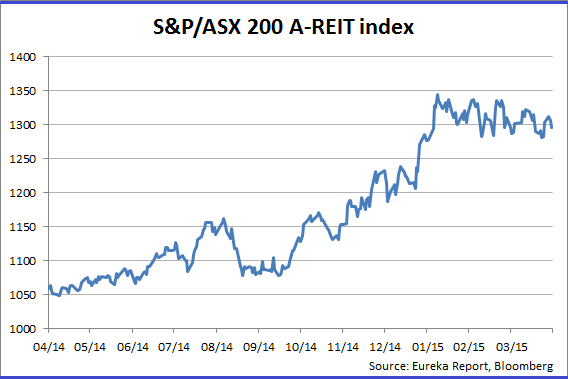
One reason for the difference is that the stock market gives liquidity – in other words instant access to cash by selling on the market.
By contrast, while direct investment in property can generate liquidity, it is usually a much slower process … in other words you must sell the entire property.
While that liquidity advantage in the listed property trusts accounts for at least some of the premium, the share market is basically saying to the valuers that in today's lower interest rate environment we think you might be wrong.
When bonds are yielding only two per cent, it is not unreasonable for property to be valued on a yield of five per cent.
The pricing of listed property trusts is made more complex by the fact that they boost returns by borrowing at interest rates lower than the yield on the property and many of them have property developments in their portfolios which is a high-risk, high-yield activity.
But the Bunnings Property Trust (BWP) yields around five per cent and is priced at about 30 per cent above the book value of its assets. That company is a pure property investment company which illustrates these trends very clearly.
Industrial and office properties currently yield between 6 and 7.5 per cent when they are sold to big institutions. These properties actually return much more than the yields being offered by the stock market via listed trusts. So the question is, can smaller investors get access to these high yielding properties allowing that they need to forego liquidity offered via listed trusts?
All of us remember the unlisted property trusts that existed prior to the global financial crisis. They were structured on the basis that investors had the right to cash their units in at very short notice. Many financial planners put their clients into these funds and were trading them in just the same way they traded share portfolios.
The problem was that liquidity came about because the funds were increasing in size as money poured in. But when the market turned and the money stopped coming in there was big trouble: Redemptions had to be suspended because the assets could not be sold quickly. Given that it was a tough property market, if they were sold proceeds would be substantially below what the valuers had said they were worth during the boom time. That structure was inherently unstable.
The stigma about unlisted property trust still hangs around as a result of the crashes but a number of unlisted property trusts are emerging that are structured more carefully. It is possible to get yields of between 6.5 and 7.5 per cent on these trusts.
The yields come about partly because the property is being directly purchased and partly because interest on borrowings for these properties is often around four per cent so instead of being negatively geared they are being positively geared.
In theory you can borrow money to invest in these trusts but be aware of that because the trusts often borrows up to 35 – 45 per cent of their assets and the rate of return is already boosted by lower interest rate debt. If you borrow money to invest in these trusts the end result is a very highly leveraged investment.
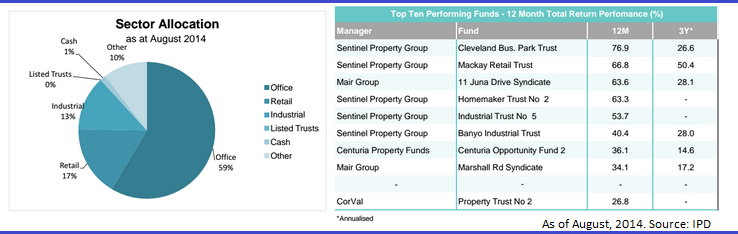
Research group IPD compiles a performance league table each month, releasing details of the top five funds and syndicates. The top performing fund, Sentinel Property Group's Mackay Retail Trust, returned 61.5 per cent over the 12 months to July 31. Sentinel took four of the top five positions for the month.
It is worth looking around the market for these trusts. Australian Unity, Cromwell Group and Centuria have unlisted funds. Some of them provide liquidly by holding cash which, of course, ultimately lowers the total returns.
Frankly I prefer to have liquidity elsewhere in the portfolio and sacrifice direct property liquidly for better returns and avoidance of a crisis risk.
I was yarning to the Charter Hall Group, a company which set up office and industrial unlisted property trusts that have limited size. Their direct office property fund has some $500 million in property which they are lifting to $700 million with a prospectus. And they are starting an industrial property trust which they will cap at $250 million. These investments are not for everyone but they are yielding around seven per cent after a 0.5 per cent management fee is deducted, which is above what the market tells us they would yield if they were listed.
When you invest, your money is locked up for five years and at that the end of that period you have the option to cash in your units or invest for another five years. In the case of the Charter Hall direct office fund it reached the five year period and 25 per cent of the holders took the cash with 75 per cent rolling over for another five years.
The fund sold some properties to raise funds for those wanting cash and it is now restoring its former size by buying additional properties.
What I look for in unlisted property funds is long tenancies so when the fund comes up for redemption the tenants' leases still have a way to go. Property that is being sold today has risen in value because of lower interest rates but to be able to get seven per cent when the bond rate is two per cent indicates that in the unlisted market there is a substantial yield premium that is above normal levels.
I must emphasise that five years in an unlisted property trusts is not for everyone and it would need to be part of a portfolio of assets that was dominated by lots of liquidity. But in addition they are not nearly as exciting to discuss at BBQs as houses are.





 Call 1300 880 160
 Start a chat
 Schedule a call