
Eureka's Week: Gottliebsen on rates, super, Trump





Term deposit rates | Super | Trump | Readings & Viewings | Last week | Next week
Eureka's Week
Robert Gottliebsen

Term deposit rates on the rise?
When you arrive back from overseas after being away for nearly a month there is always a surprise. My surprise came when I walked into our local branch of the Bendigo Bank for tidying up purposes and to confirm that a small term deposit had matured and been reinvested for another year – of course, at a lower interest rate.
But in a few weeks I have a larger five-year deposit coming due and, sadly, the Bendigo Bank's official rate is 3.1 per cent. But, I learned, there was a good chance that if I negotiated I might get 3.3 per cent.
As I discuss below, there remains the whole question of whether you should be investing superannuation money at those sorts of low rates. But what I found fascinating is that longer term rates are on the rise – those sorts of interest rates were simply not available when I left for Newfoundland a month ago. And these increases are coming when just about every analyst is staking his or her reputation on an official interest rate cut next month.
What is happening is that these longer term deposits don't require as much capital backing, so banks are more interested in paying a higher rate and, even more importantly, they are worried about the stability of the Australian banking system's overseas money. The big four banks make a fortune by borrowing at low rates overseas, hedging the currency risk and then loaning the money to homeowners.
That formula almost caused a disaster during the global financial crisis because the overseas tap was turned off. As Callam Pickering pointed out in Eureka Report (click here to read his article from this week) one of the major banking players in Europe, Deutsche Bank, has a weak balance sheet and if global money markets get put under pressure Australia will be squeezed again ... although much of our overseas borrowing is now longer term so there will not be an immediate crisis.
In the one-year local term deposit market, most of the large banks are offering 2.45 per cent but NAB, via UBank, is offering 2.86 per cent and Bendigo 2.6 per cent. In the five-year space the official rates are between 3 and 3.1 per cent with the Commonwealth at 2.9 per cent. But if you have a substantial sum that is rolling over and want to commit it to five years, make sure you negotiate and/or shop around.
But should you be committing money on bank deposit at between 3 and 3.3 per cent?
Remember, bank deposits of under $250,000 are government guaranteed so have the same security as an Australian government bond and the bond rate for 10 years is below 2 per cent – so you are getting a more than 50 per cent greater return than the 10-year bond rate.
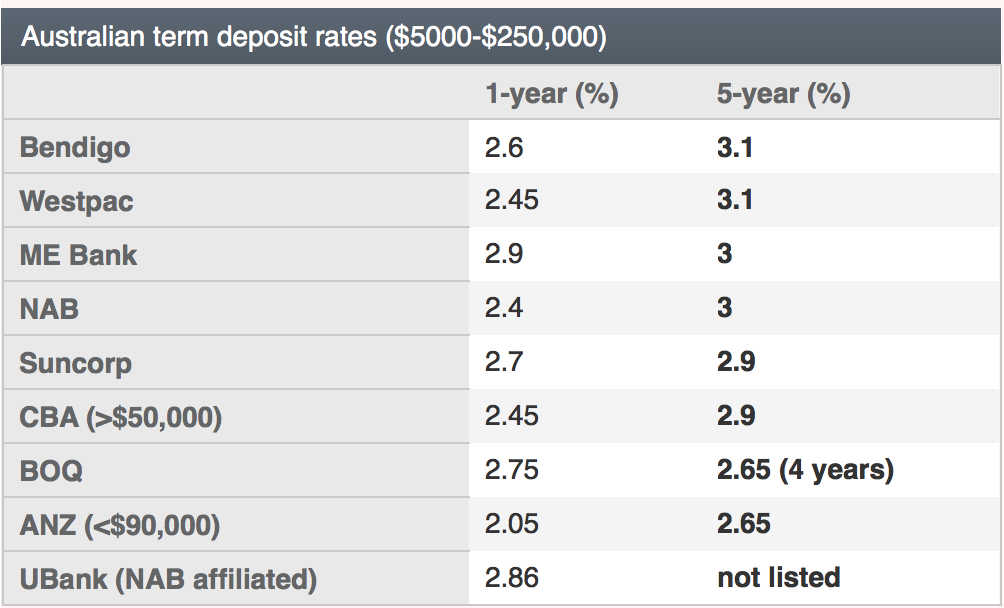
Of course, after deposits with a particular bank exceed $250,000 there is no government guarantee. With inflation around 2 per cent, a 3.3 deposit rate has a 1.3 per cent real return with no risk. But there is one big difference between a term deposit and a bond – if you need to cash in the term deposit, you lose heavily. Bonds can be sold.
So – particularly if your fund is in pension mode – you need to be very careful about how much money you tie up in bank term deposits.
Nevertheless, my view is that in a portfolio that has equity and higher interest bearing securities, there is a role for investment in ‘bonds' via government guaranteed bank deposits as part of a hedge against recessionary risk. Of course if the analysts are right and the official rate is going down from 1.75 per cent to 1 per cent (I am not sure if they are right) then a 3.3. per cent rate starts to look very attractive, albeit at a terrible time for gaining returns.
The real temptation is to simply switch to bank shares where the returns are far greater. And of course all properly balanced portfolios have a share content, including a bank share content. Bank shares are now rising and the doomsayers, which include some of our largest investment banks, have egg on their face. The two most dangerous things that might happen to banks are, firstly, possible problems in overseas capital markets and, secondly, a substantial decline in house prices which would lead to defaults.
From what I can tell around the suburbs, local demand for houses and apartments in Sydney and Melbourne is still strong and they show no sign of declining. Moreover, the planning ministers are not increasing the supply of dwellings, particularly in Sydney and Melbourne, so there will be long-term shortages. The one exception is the massive apartment developments in inner city Melbourne (to a lesser extent Sydney) where Chinese investors have bought vast numbers of small one-bedroom apartments off the plan and it doesn't look like they can pay for them. That will cause considerable oversupply unless there is a sudden buying surge, perhaps from Hong Kong.
Shorten's power on super
I want to talk about the last budget – and the Coalition government made a complete hash of superannuation and are now trying to fix up some of the mistakes they made on a piecemeal basis. They got it wrong because they introduced what we all know was retrospective legislation, but they kept claiming it was not retrospective, which was a complete nonsense. They are now trying to fix the problems that are always created when governments legislate retrospectively.
Don't get too hung up about the superannuation debate in the Coalition. What happens in the Senate is far more important. Bill Shorten and the crossbenchers will decide what superannuation legislation will be passed and what will be rejected. Shorten would have been prime minister except for the small swing in his home state, Victoria, because of the Victorian Government's CFA disaster. Accordingly, Shorten acts a bit like a PM in exile and he wants to be known in the community as a person who will look after people's superannuation. Super is set to be the community's largest asset as home ownership falls and Shorten can see himself as the custodian of superannuation, just in the same way he wants to be the custodian of Medibank. There is a good chance he will decide what the government can or cannot do on superannuation policy.
This is smart politics and leaves the government flat footed. Horrible as it may seem, we are headed for more months of superannuation uncertainty until the Senate resolves the situation.
If Trump wins…
Finally, a word about Donald Trump. The message I got from North America is that he has a real chance of winning and countries like Australia have done nearly not enough work to understand what a Trump presidency would mean (please do not take that as a forecast but, rather, as a warning not to write him off because of what you read in the politically- correct press). If Trump wins or goes close we are likely to see the rise of the ‘nation state', less globalisation and greater friendship between the US and Russia. We will know more about the likelihood of Trump being president and what that might mean in coming months.
Readings & Viewings
The Babe Ruth effect – and why it's the magnitude, rather than frequency of wins and losses in your portfolio, that matters.
This tool from Choice will help you generate a complaint letter for compensation if your flight is cancelled or delayed.
John Hewson on how to start fixing Australia's broken politics.
As Eagle Boys' head office goes into administration, it's interesting that the good ol' local takeaway shop holds more than half the Aussie pizza market.
The US justice department has been pursuing this currency trading scheme for years – and two HSBC bankers were the first to be arrested this week.
Highlights from this week's Republican national convention: Donald Trump's family adamant he “gets things done”.
“If it came down to Satan and Donald Trump at the convention, I might consider supporting Donald Trump”... yet many delegates remained unconvinced of his potential, apparently.
A reminder of the freaky clairvoyant powers of The Simpsons.
The discipline of Olympic archers.
Behind the quest to build a better bicycle – a good read for physicists and cyclists alike.
The man who bought the website TrumpPence2016.com for $10 in April is now looking to sell it to the Trump campaign for a six-figure sum.
Has Britain's Labour become the new “nasty party” for female MPs?
Hillary Clinton is now running against Vladimir Putin.
Japan is about to get Pokemon GO - and government officials are urging players to use “cool names that are different than real names” to protect privacy.
Taxes and subsidies are choking Australia's wine industry.
Three approaches to writing the ultimate thriller.
What it's like to narrowly avoid disaster in a $18 million airliner Sim.
The world's first “Tesla Town” is planned for the outskirts of Melbourne.
Meet FarmBot – it'll take care of plants and crops throughout their lifetime with pinpoint accuracy.
Mitchell Sneddon's recipe of the week (in line with the Roman tradition of Gnocchi Thursdays).
And happy 60th birthday to American character actor Willem Defoe, who appeared in The English Patient and the Spiderman trilogy among many others. Here he is as a detective interviewing protagonist Christian Bale in 2000's memorable psychological thriller American Psycho.
Eagles founder Don Henley is also celebrating a birthday today, his 68th. Here he is on lead vocals on early Eagles hit “Witchy Woman”.
Last week
Shane Oliver, AMP
Investment markets and key developments over the past week
It's now four weeks since the Brexit panic on June 24 and since then US and European shares are up 6%, British shares are up 9%, Australian shares are up 7% and Japanese shares are up 11%. Fears around Brexit's global impact look to have been wildly exaggerated. The only really lasting impact (so far) has been on the British pound which is down another 3% leaving it down 11% from June 23rd, which understandably reflects the negative impact of Brexit on the UK economy.
Over the past week the rally in shares generally continued with US and European shares up slightly, solid gains in Japanese and Australian shares but a fall in Chinese shares. A combination of good economic data, good US profit results, the absence of a major negative impact outside the UK from Brexit and talk of more policy stimulus in parts of the world are continuing to help. Bond yields were generally flat to down, commodity prices were mixed and the $A fell partly in sympathy with NZ moves towards another monetary easing.
The talk around Japan's planned fiscal stimulus is continuing to get ramped up with the size of the package supposedly going from ¥10trillion, to ¥20trillion to maybe even ¥30trillion which is around 6% of GDP albeit it depends how many years it is spread over. If as we expect it's focussed on encouraging consumers to spend more then it should have a reasonable chance of success.
In maybe a sign of things to come in Australia – NZ looks to be heading for another rate cut. After a surprisingly low June quarter inflation outcome, the announcement of plans to tighten restrictions on residential mortgage lending and the Reserve Bank of New Zealand stating that “a decline in the [$NZ] is needed”, the RBNZ has clearly set the scene for a rate cut next month. In fact, it doesn't mince words stating that “it seems likely that further policy easing will be required”.
The IMF downgraded it global growth forecasts to 3.1% for 2016 (from 3.2%) and to 3.4% for 2017 (from 3.5%) on Brexit risks - but hardly a surprise. It must often strike the ordinary investor as weird that much fanfare is given to the IMF downgrading its growth forecasts but share markets seem to largely ignore it. There are several reasons for this but in essence it's because the market (and most economists) have already moved ahead of the IMF and the IMF global growth forecasts have been starting out too optimistic for years now. Since early this decade they have been starting out forecasting 4% global growth for the year ahead only to end around 3%. This is not great – but it's not bad either! Just more of the same.
One positive from the last week – we learned that Trumps can say thoughtful things. Not to worry that they were Michelle Obama's. In the week ahead it's on to the Democrat convention which may be a lot calmer.
Major global economic events and implications
US data on a roll. Housing data was strong (with solid readings for home builder conditions, starts, sales and home prices), jobless claims remain very low, leading indicators rose more than expected and while the headline Philadelphia Fed manufacturing index fell readings for shipments, new orders and employment rose solidly. The US housing recovery likely has a long way to go as housing starts at 1.2 million continue to run below underlying demand of 1.5 million with the overbuilding of last decade having been more than worked off. Buying a house in Detroit still looks like a good proposition!
Evidence is continuing to build that US profits bottomed in the March quarter. 115 S&P 500 companies have now reported June quarter earnings to date and so far so good with 81% beating on earnings and 58% beating on sales. While the market expects profits to fall 3% from a year ago, this will translate into a rise in profits of 8% from the March quarter.
As expected the ECB remained in wait and see mode at its July meeting. However, President Draghi referred to greater uncertainties in reference to Brexit and reiterated the ECB's “readiness, willingness and ability to act” if necessary. We remain of the view that its QE program will be extended beyond its current expiry of March 2017. Eurozone consumer confidence fell only fractionally in July suggesting little impact on confidence (or perhaps it was a case of good riddance). Interestingly the ECB's bank lending survey showed an increase in demand for loans and a further easing in lending standards which is also a good sign as the survey was conducted before and after the Brexit vote.
Japan's manufacturing conditions PMI showed a welcome improvement in July albeit it's still weak.
The Chinese property market recovery remains a positive for Chinese growth – with residential property prices up another 0.8% in June or 7.8% year on year. Tier 1 cities are seeing most the gains but Tiers 3 and 4 have picked up. Meanwhile, the MNI Chinese business sentiment index rose in July and significant flooding in parts of China could have a short term positive impact on GDP from rebuilding and may temporarily boost food prices.
Australian economic events and implications
In Australia, the minutes from the RBA's last Board meeting confirmed that the door is wide open for another rate cut at its August 2 meeting. While not as direct as the Reserve Bank of New Zealand, the RBA indicated that it was waiting on further information on inflation, the labour market and the housing market and the next update of the RBA's economic forecasts. Since it has described the labour market and the housing market as “mixed” and recent data on both suggest no reason to change that assessment, the implication from the RBA is that should we see another low inflation reading when the June quarter CPI numbers are released on Wednesday then it's likely that the RBA will cut the cash rate from 1.75% to 1.5% on August 2. A CPI outcome of 0.4% quarter on quarter for headline and underlying – which is what we expect - would likely be enough to see the RBA cut again.
Next week
Savanth Sebastian, CommSec
In Australia inflation data will dominate the calendar in the coming week – of particular importance in light of the upcoming Reserve Bank Board meeting. A super-low inflation result could be the trigger for another rate cut. In the US the data focus will be on the home prices and economic growth. But for investors and traders the focus will be on the Federal Reserve policy meeting on Tuesday and Wednesday.
On Wednesday inflation data will be in focus, when the Consumer Price Index for the June quarter is released. The “official” inflation data only comes around once a quarter in Australia. There is private sector monthly survey on inflation from Melbourne Institute but the Australian Bureau of Statistics only publishes its inflation measures once a quarter.The monthly inflation gauge suggests inflation should remain relatively tame over the quarter. The CBA Group is tipping a modest result. A lift of 0.5 per cent is expected over the quarter with annual inflation expected to ease from 1.3 per cent to 1.1 per cent. More importantly, investors will need to focus on the “underlying” measures that exclude petrol as well as the non- tradable price measures that focus on domestic price pressures. We expect that underlying inflation grew 0.4 per cent in the June quarter and around 1.4 per cent over the year. Such a mild result should ensure that the Reserve Bank sticks to its easing bias, and an even significantly lower inflation result would trigger an August rate cut.





 Call 1300 880 160
 Start a chat
 Schedule a call










